
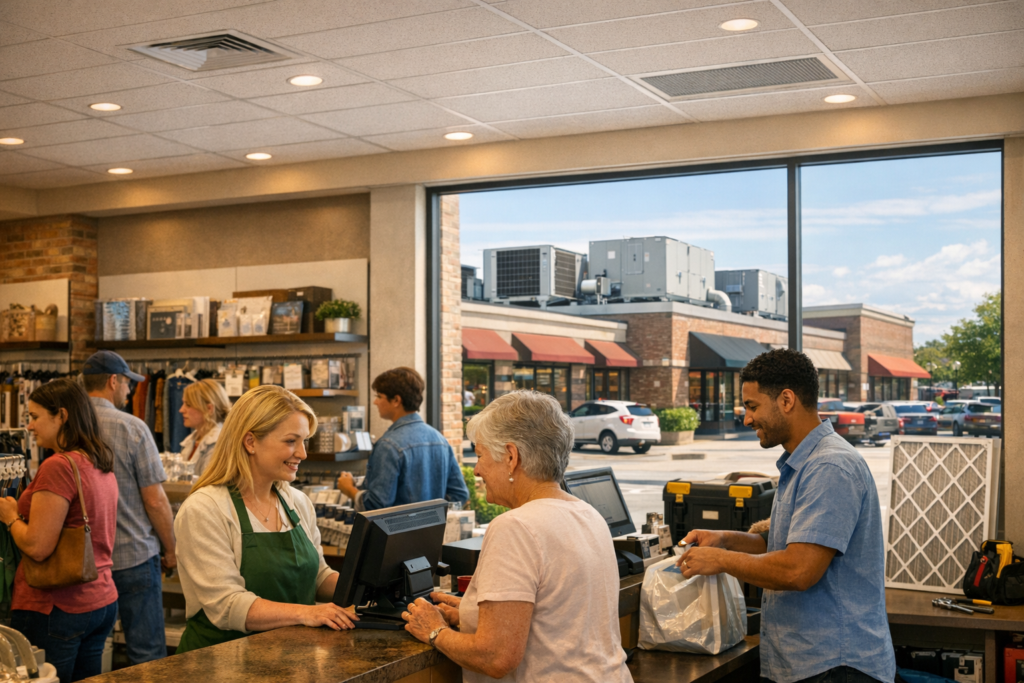
Walk into a well-run retail store and you can feel it before you see it: steady comfort, clean air, and a calm environment that keeps shoppers browsing. That’s not luck—it’s planning. Behind the scenes, retail HVAC maintenance services are the quiet playbook that protects product, staff productivity, and customer experience. In Tyler, TX, our heat and humidity can turn a small HVAC issue into a fast-moving problem, especially in high-traffic retail shops with doors opening all day. We have seen how the right maintenance habits prevent complaints at the register, shorten lines by keeping staff comfortable, and reduce surprise shutdowns that cost real revenue. Here’s what we build, tune, and protect so shoppers never notice the work—but always feel the results.
The comfort playbook: why retail HVAC systems shape shopper behavior
We think of HVAC as “just cooling,” but in retail stores, comfort is part of merchandising. If a space feels muggy, stale, or uneven, shoppers move faster, staff gets distracted, and the store’s brand takes a hit. Retail HVAC systems also run differently than residential equipment: longer run times, heavier filtration loads, and constant door cycling. That’s why commercial HVAC maintenance matters even when everything seems “fine.”
When we evaluate HVAC system performance and reliability, we start with how the building behaves during peak conditions. In Tyler, TX, that might be a 100-degree afternoon with heavy humidity and a rush of customers. In shopping centers and strip malls, it could be shared walls, rooftop units with different schedules, and outdoor air infiltration from common corridors.
Comfort isn’t just temperature—it’s consistency
Consistent comfort requires more than changing filters. We look for the causes of hot and cold spots and fix the root issues that retail HVAC systems develop over time:
– Thermostat calibration and controls that drift and “hunt,” causing swings
– Dirty coils that reduce heat transfer and create longer run cycles
– Loose belts, worn pulleys, or failing fan motors that weaken airflow
– Poorly balanced supply and return air that leaves certain aisles uncomfortable
This is where preventive HVAC maintenance becomes a business tool, not a “nice-to-have.” A disciplined HVAC maintenance plan reduces downtime by catching small performance losses before they become customer-facing problems.
IAQ is what shoppers remember without realizing it
Indoor air quality (IAQ) affects how long people want to stay in a space. If the air feels stale, dusty, or overly humid, shoppers often blame the store rather than the system. We improve indoor air quality (IAQ) by combining filtration strategy with airflow verification, drain line maintenance, and targeted ductwork inspection and cleaning when needed. For retail shops that carry fabrics, paper goods, or seasonal inventory, indoor air quality (IAQ) can even influence product condition and odor control.
When we talk to store managers, we usually frame the goal simply: maintain comfort, protect the brand experience, and keep the doors open. Commercial HVAC maintenance is the hidden layer that makes that possible day after day.
Retail HVAC maintenance services in Tyler, TX: what we inspect, tune, and document
In Tyler, TX, we build our retail HVAC maintenance services around what actually causes most HVAC system failures / breakdowns: airflow restrictions, electrical wear, refrigerant issues, and controls that drift. A real maintenance program is not a quick glance—it’s HVAC inspections and tune-ups with documentation, trend tracking, and next-step recommendations.
Our approach also supports OSHA and building code compliance because retail environments are public-facing spaces. When equipment is maintained, it’s safer, easier to operate, and less likely to fail in a way that creates hazards (like water leaks, electrical issues, or poor ventilation).
What a scheduled visit should include
When we perform scheduled HVAC inspections, we typically address the items that protect HVAC system uptime / reduced downtime and improve energy-efficient HVAC operation:
– Filter condition, correct sizing, and fit (no bypass gaps)
– Coil condition and cleaning when needed (evaporator and condenser)
– Condensate drains and overflow protection to prevent water damage
– Electrical components: contactors, capacitors, wiring integrity, amp draws
– Refrigerant circuit checks for signs of leaks or undercharge
– Blower assembly and fan performance for proper airflow
– Thermostat calibration and controls verification, including scheduling
– Safety checks tied to OSHA and building code compliance
We also document what we find so a retailer isn’t guessing. Over time, those records help prioritize capital decisions and support warranty protection / manufacturer warranty requirements.
How often should a retail store schedule inspections?
Most retail stores benefit from at least quarterly service, and some sites need more. Restaurants and food service often require tighter intervals because grease, heat loads, and extended hours stress equipment. Grocery stores and supermarkets can be a category of their own due to humidity control, high traffic, and sensitivity to temperature swings around refrigerated areas.
A solid preventive HVAC maintenance program is built around your operating schedule, your unit count, and your busiest seasons. We have found that planned timing is what produces utility cost savings and fewer emergency calls, especially when summer arrives early in East Texas.
For broader guidance on building ventilation and indoor air considerations, we often reference resources like the U.S. Department of Energy for energy efficiency and HVAC best practices: https://www.energy.gov/energysaver/heating-and-cooling
Maintenance programs that reduce downtime and lower energy bills
Retail doesn’t pause when an HVAC unit struggles. One rooftop unit running poorly can spike utility cost savings goals in the wrong direction and create a chain reaction of complaints. We design HVAC maintenance plan options that focus on energy-efficient HVAC operation and measurable stability. The big win is avoiding preventable HVAC system failures / breakdowns and keeping HVAC system uptime / reduced downtime high during peak sales periods.
Commercial HVAC maintenance should pay for itself by reducing wasted run time, preventing premature replacements, and limiting emergency HVAC repair calls. We’ve seen stores cut comfort complaints dramatically after a few cycles of consistent service, especially when controls and airflow are corrected.
How preventive maintenance creates utility savings
Energy waste in retail HVAC systems usually comes from friction and inefficiency rather than a single catastrophic issue. A preventive HVAC maintenance checklist targets the most common efficiency drains:
– Dirty coils forcing longer cycles (more kWh, more wear)
– Clogged filters reducing airflow and freezing coils
– Incorrect refrigerant charge lowering capacity and efficiency
– Poor thermostat calibration and controls causing overcooling or short cycling
– Failing fan motors drawing higher amps than normal
When we tighten these variables, we see more stable temperatures and lower energy bills over the season. More importantly, we protect HVAC system performance and reliability so retailers can focus on staffing and inventory, not comfort emergencies.
Smart monitoring and controls: the modern retail advantage
We’re big believers in HVAC system monitoring and smart thermostats for multi-site operators, shopping centers and strip malls, and any retail brand that wants consistency. Monitoring helps us catch:
– Temperature drift after hours (schedule overrides or stuck dampers)
– Unusual run times indicating coil fouling or low airflow
– Early signs of refrigerant loss before cooling capacity collapses
Smart controls also allow better scheduling, which supports energy-efficient HVAC operation without sacrificing comfort. Combined with scheduled HVAC inspections, monitoring is one of the fastest ways to increase HVAC system uptime / reduced downtime and reduce after-hours emergency HVAC repair events.
A maintenance program should feel like a plan, not a gamble. When we build a preventive HVAC maintenance program, we’re aiming for repeatable performance—season after season—without surprise spikes on the utility bill.
Different retail buildings, different risks: groceries, restaurants, strip malls, and mixed-use spaces
Not all retail stores behave the same. The building type, foot traffic, and products sold can change what “good HVAC” looks like. We tailor commercial HVAC maintenance to the property’s risk profile, because the wrong plan creates blind spots.
Shopping centers and strip malls often have multiple rooftop units across different tenant spaces, sometimes with shared electrical constraints, roof access coordination, and varied operating hours. Office buildings and mixed‑use spaces add complexity with separate zones, different ventilation expectations, and tenant comfort requirements that shift during the day.
Grocery and food environments: comfort plus safety
Grocery stores and supermarkets have unique needs because comfort, humidity, and temperature control can affect more than shopper experience. Even when we aren’t servicing the refrigeration rack itself, we still consider refrigeration and food safety for retail as part of the environment. Poor humidity control can create condensation, slippery floors, and discomfort near cases.
For grocery stores and supermarkets, we often emphasize:
– Indoor air quality (IAQ) and humidity management for comfort and cleanliness
– Scheduled HVAC inspections that focus on drainage and airflow
– Ductwork inspection and cleaning where dust or debris impacts airflow
– Controls verification to keep temperatures steady during busy hours
In restaurants and food service, we commonly coordinate HVAC maintenance plan schedules with kitchen exhaust and occupancy patterns. Heat loads can be intense, and equipment can run long hours, so preventive HVAC maintenance is essential to avoid breakdowns during dinner rush.
Strip malls and mixed-use: coordinating systems and expectations
In shopping centers and strip malls, one tenant’s comfort problem can become a property management issue quickly. We help owners and managers create customized HVAC maintenance contracts that standardize service quality across multiple tenants and reduce confusion about who handles what. For office buildings and mixed‑use spaces, we pay close attention to zoning, controls, and airflow so one suite doesn’t freeze while another overheats.
Across all building types, we keep a close eye on equipment lifespan / extend equipment life strategies. Retail HVAC systems are a major asset, and extending service life by even a few years can reshape a capital budget.
Service agreements that protect warranties, compliance, and your brand
A strong HVAC maintenance contract / service agreement isn’t just paperwork—it’s a protection strategy. We use it to clarify service frequency, response expectations, documentation, and the responsibilities that support warranty protection / manufacturer warranty terms. Many manufacturers expect proof of routine commercial HVAC maintenance, and we make sure our customers have the records they need.
This structure also supports OSHA and building code compliance by ensuring equipment is maintained, safe to access, and operating within expected parameters. For retailers, compliance is not abstract—it reduces liability and helps keep operations steady.
What to look for in a maintenance contract
When we build customized HVAC maintenance contracts, we focus on real-world retail needs:
– A clear maintenance program schedule (seasonal and quarterly options)
– Written scope that includes HVAC inspections and tune-ups
– Priority response pathways for emergency HVAC repair
– Reporting that highlights risks for HVAC system failures / breakdowns
– Recommendations that improve HVAC system performance and reliability
We also align the plan with the retailer’s busiest seasons, because the worst time to discover a weakness is during a promotion, a holiday weekend, or a heat wave.
When emergency repair is unavoidable, response matters
Even with preventive HVAC maintenance, components can fail. What matters then is response speed and parts readiness. Our goal is to minimize disruption and restore comfort fast, while also diagnosing why the failure happened so it doesn’t repeat.
Emergency HVAC repair should be the exception, not the norm. A well-run commercial HVAC maintenance schedule reduces downtime, supports HVAC system uptime / reduced downtime, and keeps retail shops from losing sales due to uncomfortable conditions.
As Olympus Air & Heat commercial HVAC experts, we’ve built our process to be consistent, documented, and easy for managers to approve—because retail is busy, and HVAC should not add stress.
We provide commercial HVAC services in Tyler, TX with a focus on dependable planning, not guesswork. Our licensed HVAC technicians work across retail HVAC systems in everything from restaurants and food service to grocery stores and supermarkets, as well as office buildings and mixed‑use spaces.
If you want retail HVAC maintenance in East Texas that prioritizes comfort, indoor air quality (IAQ), and stable operating costs, we’re ready to help. We’ll review your equipment, propose an HVAC maintenance plan that fits your hours and budget, and build a service agreement that supports warranty protection / manufacturer warranty needs while reducing emergency HVAC repair calls. Schedule a visit with our team here: https://olympusairetx.com/